Locomotives
“Black Five” 5”g Class 5 mixed
traffic engine
“Speedy” 5”g 0-6-0 tank engine
“Doris” 3½”g Class 5 mixed traffic engine
“Juliet” 3½”g 0-4-0 tank engine
“Bat” O gauge 4-4-0 British Schools Class express engine.
“Highlander” 7.25”g Black Five
“Black Five” 5”g Class 5 mixed traffic engine
This engine took 3 years to build and 1000 hours in the workshop.
Come for a brief footplate ride, via Youtube.

(Click for a larger view)
There's a lot involved in making an engine. Here is a very quick tour...
Boiler making, in copper and silver solder...

Fly cutting on the mill...

Milling...

Turning on the lathe...

Reaming...


Assembling (That's me folks)...

And finally, testing (my good friend John Lyas)...
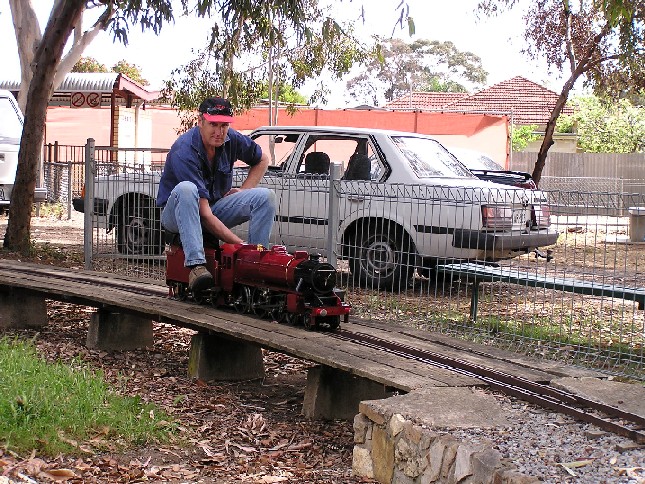
You might be interested to know that the Black Five is being adopted as the basic layout for a new, modern design of steam locomotive, called the 5AT .

“The 5AT is a totally new steam locomotive design, incorporating the latest proven steam locomotive technology, for hauling main line steam charter and railcruise trains. With a 100% increase in thermal efficiency over "classic" steam, and 3500 horsepower available from the cylinders (more than a "Deltic"), its perfomance will amply demonstrate what could have been achieved had steam locomotive development been fully exploited in the 20th Century." (Courtesy 5AT project)
“Speedy”
5”g 0-6-0 tank engine

(Click for a larger view)
"Speedy"
was designed, and named, by the well-known live steam author “LBSC”, following
a Great Western Railways (UK) prototype. She weighs 70 kg and runs on 5"
gauge track. This was a three year project
also, and I booked about 600 hours in the workshop.
Speedy has been
around, here shown in her
original colour at Penfield with the dynamometer car.

“Doris” 3½”g
Class 5 mixed traffic engine

"Doris"
also was designed and named by “LBSC”, and she is also a “Black
5”. Yes, I really like Black Fives
except for the colour! I built Doris
over ten years, starting as a high school student, and taking long breaks while
I studied and travelled.
These days,
there is a trend to build larger locomotives and 7¼ “ gauge
is very popular. But when I started 5”g
was considered large and 3½” was the dominant gauge even for public passenger
hauling. I’m still an avid supporter of
the smaller gauge because it embodies the real spirit of classical model
engineering, and in some respects it’s more satisfying because there are
different challenges in building and driving.
Other advantages of the smaller gauges are that engines are easier to
transport, they are cheaper and faster to build, and require smaller workshop
resources. Therefore, they are more
accessible to beginners to the hobby, particularly the young or those with
limited resources, as I was at the time.
Doris still
sees regular public passenger-hauling use at SASMEE. The photo was taken at Cobden, Victoria
during a model engineers’ convention.
When Doris was
45 years old I refurbished her, with remachined axleboxes and motionwork, new superstructure, a new tender tank and a
repaint. I was honoured to receive the Hugh Elsol memorial award for her in
2017 in Bunbury WA.

(Click for larger image)
She's now a look-alike with my 7.25"g "Highlander", which is double the size. Here's a picture in my workshop (Click for larger view) …

“Juliet”
3½”g 0-4-0 tank engine

This is a picture of "Juliet", my first successful passenger-hauler. She is 1/16 scale, weighs 15 kg, and runs on 3.5" gauge track. I finished Juliet when I was 16 years old. Juliet is an ideal beginner's locomotive and building her taught me invaluable skills in my father's workshop. I took her along to a job interview when I was in matriculation, and was offered a cadetship to study mechanical engineering. So she has had a profound influence on my career.
Now, after building all the above engines, and with the benefit of experience, better tools and more skill, Juliet has been refurbished and is a startling performer as well as a great crowd-pleaser. I entered her in the 2007 efficiency trials and you can see detailed dynamometer records under the “dynamometer car” page.
Here is some Youtube video of Juliet performing at a SASMEE field day.
“Bat”
“O” Gauge (32mm) live steam 4-4-0 British “Schools” class
When I was a boy I had a classical tinplate clockwork train set in “O” gauge made by Hornby. After making a few small marine engines in Dad’s workshop, I boldly set out to build a real O gauge steam locomotive, to a design by LBSC published in the English Model Engineer in 1939. He called it “Bat” because it was a project you could build in your kitchen during the long evenings of blackout as WW2 was starting. It was a complete failure: I was simply too inexperienced, at the tender age of 14. Recently, I decided to try again, building a “Bat” from scratch. Yes, I’ve had many comments from my good friends building in 5”g and larger that it must be just too fiddly! But I point out that it’s no more difficult than making a lubricator, injector, steam pump or turbo generator for a larger locomotive. It’s taken almost a year, but it has been just as fascinating and rewarding as building any of the larger engines.
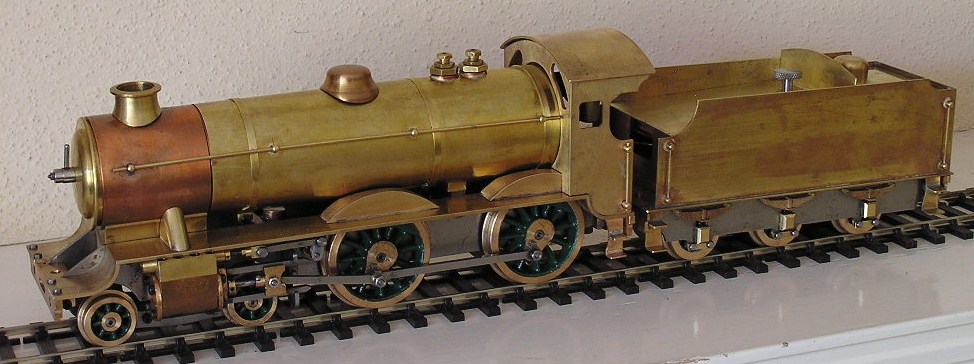
I was a little reluctant to paint over the brasswork, but eventually I plucked up the courage…(Click for a larger images)
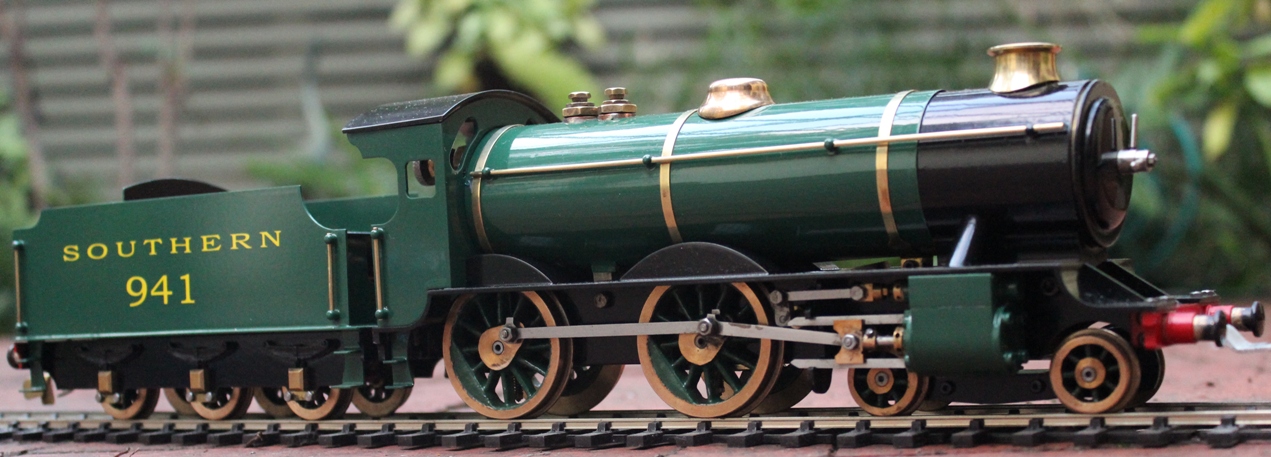
Here are some more pictures you can click to…


The whole engine has spring suspension. This is the tender.

This is the boiler and the butane burner which I developed specially.

A view of the slip-eccentric motionwork.

A view with a steam chest opened.

A view from the tender end.

A view of the underside. The batteries are for the radio control receiver, not for the engine!

Tender top and cab roof removed, showing the butane tank and radio control.

One departure from LBSC’s design is that I have adopted butane firing. It runs for 30 mins on one boiler filling. It has displacement lubrication and superheat.
See Bat running on Youtube: Running with 7 Pullman coaches
“Highlander” 7.25”g Black Five
From one end of the range to the other! While I was building the red Black Five in 5”g (see above) a friend (Terry Tresize) was building the same engine in 7.25”g, and we enjoyed comparing notes. Terry had the chassis running air, and had done a magnificent job, but after many years decided it was time to stop. I was pleased to take it over and finish it off, over a period of 3 years.
